

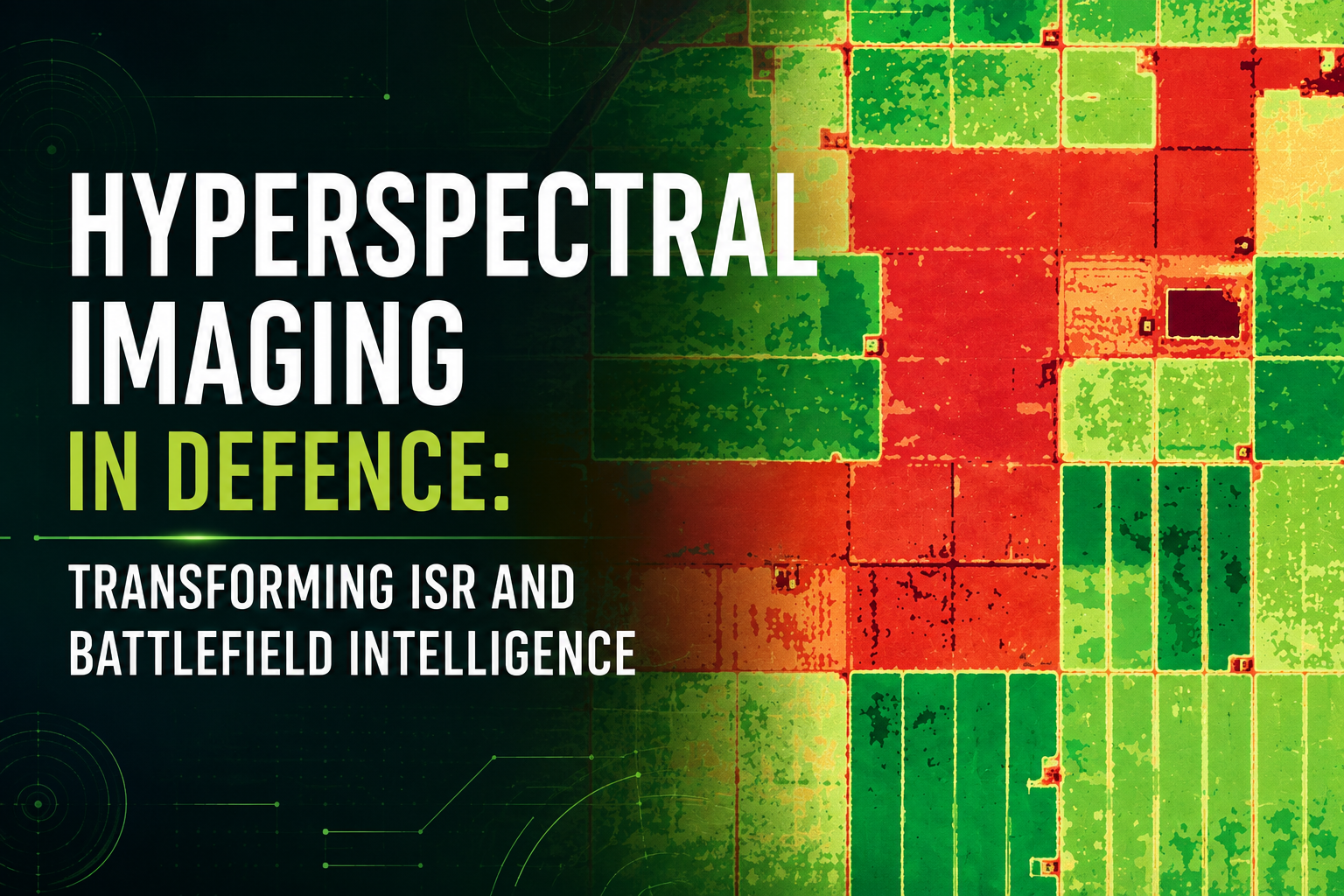
Hyperspectral Imaging in Defence: Transforming ISR and Battlefield Intelligence
Modern defence operations increasingly depend on the ability to detect, identify and assess objects and activities beyond what the human eye can see. Hyperspectral imaging in defence is emerging as an advanced sensing technology that can provide this additional layer of intelligence.
Unlike conventional cameras that capture information across visible light, hyperspectral sensors collect data across hundreds of narrow spectral bands. This creates a detailed spectral signature for objects, materials and terrain. For military and intelligence applications, this capability can support more accurate target detection, surveillance, reconnaissance and battlefield awareness.
As defence forces move towards network-centric and data-driven operations, technologies such as hyperspectral imaging can become an important component of next-generation Intelligence, Surveillance and Reconnaissance (ISR) systems. For Indian defence manufacturers such as IoTech Defence, the integration of advanced sensing, autonomous platforms and indigenous technologies represents an important direction in building future-ready defence capabilities.
How Does Hyperspectral Imaging Work?
A conventional camera primarily records information based on colour and intensity. A hyperspectral sensor, however, analyses how materials interact with light across a much wider range of wavelengths.
Every material, including vegetation, soil, metals, fuels and certain man-made surfaces, can produce a distinctive spectral response. By analysing these responses, hyperspectral imaging technology can help identify differences that may not be visible in a standard image.
For defence applications, this means sensors can potentially distinguish between natural terrain and man-made objects, identify unusual material signatures and provide additional information for intelligence analysis.
The technology can therefore complement existing electro-optical, infrared and other military surveillance sensors, creating a more comprehensive picture of the operating environment.
Key Applications of Hyperspectral Imaging in Defence
1. Advanced Target Detection and Identification
One of the major applications of hyperspectral imaging for defence is target detection. Spectral information can help distinguish objects from their surrounding environment based on material characteristics rather than visual appearance alone.
This can support the identification of potential targets, vehicles, equipment or other objects during surveillance missions and provide additional data for intelligence teams.
For indigenous defence technology developers such as IoTech Defence, the ability to integrate advanced sensors with UAV platforms can open new possibilities for intelligence gathering and precision surveillance.
2. Camouflage and Concealed Object Detection
Modern military camouflage is designed to reduce visual detection. However, camouflage may not completely replicate the spectral characteristics of the surrounding environment.
Hyperspectral sensors for defence can analyse these spectral differences and potentially assist in detecting concealed or camouflaged objects. This capability can be valuable for reconnaissance missions where conventional visual imagery may not provide sufficient information.
When combined with other sensing technologies, this can contribute to a more comprehensive approach to military target detection and battlefield intelligence.
3. Battlefield and Border Surveillance
Persistent surveillance is critical for maintaining situational awareness across sensitive areas and operational zones. Hyperspectral imaging for military surveillance can provide detailed information about terrain, vegetation and man-made objects.
When integrated with UAVs and other airborne platforms, the technology can support wide-area observation while providing intelligence that goes beyond conventional imagery.
This aligns with the broader evolution of indigenous UAV capabilities in India, where companies such as IoTech Defence are developing Made-in-India defence drone systems for diverse operational requirements.
4. UAV-Based ISR Missions
The integration of hyperspectral sensors with UAVs is particularly significant for modern defence operations. Unmanned platforms can carry advanced sensors into areas that may be difficult or risky for manned aircraft to access.
For UAV-based ISR, hyperspectral imaging can add another layer of information to electro-optical and infrared payloads. Combined with AI-based analytics and other sensor inputs, this can contribute to faster intelligence processing and improved situational awareness.
For defence manufacturers, the challenge is not simply developing an airborne platform but creating an integrated system where the UAV, payload, communication architecture and data-processing capabilities work together effectively.
Hyperspectral Imaging vs Conventional Imaging
The primary advantage of hyperspectral imaging is the depth of information it provides. A standard image primarily answers “What does the object look like?” Hyperspectral imaging can provide additional information about “What is the object made of?”
This distinction can be valuable in defence intelligence, where accurate identification is often more important than visual recognition alone.
However, hyperspectral systems also involve challenges such as higher data volumes, processing requirements, sensor complexity and environmental considerations. Effective deployment therefore requires integration with suitable processing, AI and sensor fusion capabilities.
This is where indigenous defence ecosystems can play an important role by developing UAV platforms and mission systems designed around specific operational requirements rather than treating the sensor as a standalone component.
The Future of Hyperspectral Imaging in Defence
The future of hyperspectral imaging in military and intelligence applications will increasingly depend on combining advanced sensors with AI, edge computing and autonomous platforms.
As UAVs, unmanned systems and network-centric warfare capabilities continue to evolve, hyperspectral sensors could become part of integrated ISR architectures designed to provide commanders with richer and more actionable intelligence.
For organisations such as IoTech Defence, the larger opportunity lies in contributing to an indigenous defence ecosystem where UAVs, advanced payloads, AI-driven analytics, secure communications and autonomous systems work together to support mission requirements.
For defence forces, the objective is not simply to collect more data—it is to transform sensor data into actionable intelligence, faster decision-making and improved battlefield awareness.
Hyperspectral imaging represents one of the technologies contributing to this evolution, adding a new spectral dimension to modern defence surveillance and intelligence capabilities while supporting the broader vision of Atmanirbhar Bharat and indigenous defence technology development.
Frequently Asked Questions
1. What is hyperspectral imaging in defence?
Hyperspectral imaging in defence is an advanced sensing technology that captures information across hundreds of narrow spectral bands. It helps identify and differentiate objects, materials and terrain based on their unique spectral signatures, supporting surveillance, reconnaissance and intelligence operations.
2. How is hyperspectral imaging used in military operations?
Hyperspectral imaging in military applications can support target detection, camouflage detection, terrain analysis, border surveillance and intelligence gathering. When integrated with UAVs and other ISR platforms, it can provide information beyond conventional visual imagery.
3. Can hyperspectral imaging detect camouflaged objects?
Yes, hyperspectral imaging can potentially assist in camouflage and concealed object detection by identifying differences between an object’s spectral signature and its surrounding environment. Its effectiveness depends on environmental conditions, sensor capabilities and data-processing techniques.
4. What role does hyperspectral imaging play in ISR?
Hyperspectral imaging can add an additional layer of intelligence to Intelligence, Surveillance and Reconnaissance (ISR) systems. When combined with electro-optical, infrared and other sensors, it can support target identification, intelligence analysis and improved battlefield situational awareness.
5. Can hyperspectral sensors be integrated with defence drones?
Yes. Hyperspectral sensors for defence can be integrated with suitable UAV platforms for aerial surveillance and reconnaissance. Such integration requires careful consideration of payload capacity, power consumption, data processing, communications and mission-specific operational requirements.